MUSING
Watching the World Burn from Seat 14A
Seeing Beirut hit from the air forced me to confront an uncomfortable question: what good are witnesses who can do nothing?
29 November 2025 · 4 min · Kate
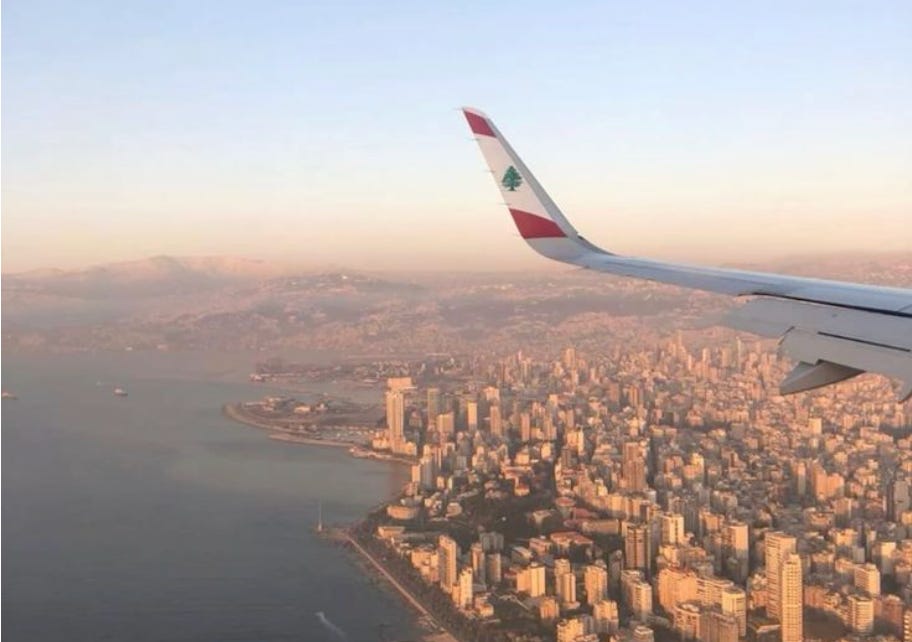
Flying out of Beirut last Sunday, the city slipped away beneath us in that soft, rose-coloured light that tricks you, momentarily, into believing the world is benign. And then, mid-ascent, the plume rose. Israel had struck the southern suburbs again. From the air it looked almost delicate - a thin grey column unfurling upwards like a private signal sent to no one in particular. It is extraordinary how war, viewed from altitude, loses its noise before it loses its meaning.
For the first time I understood why the Greeks insisted the gods lived on mountaintops. The higher you are, the less agency you have. Omniscience without intervention is not divinity; it is helplessness dressed in better robes. I looked down at the plume and realised that, from the sky, I had the perfect vantage point to witness human cruelty, and absolutely no power to alter its course. Perhaps this is what a higher power feels like, if a higher power exists at all: condemned to watch the ants set fire to one another, unable (or unwilling) to interfere.
And then came the more uncomfortable truth: there was nothing to do with those five and a half hours except choose how to spend them. I could sit there steeped in horror, rehearsing all the correct emotions of dutifully grieving strangers I would never meet, or I could accept my insignificance, order a hot chocolate, and watch Gossip Girl at 35,000 feet. I chose the latter. A small, human betrayal of grand human suffering. An act repeated a thousand times a day by anyone with a smartphone and a train to catch.
The role of the observer is a pair of shoes we slip into so easily we forget we’re wearing them. You pass a Big Issue seller on the way to the supermarket, and for three or four seconds, a generous estimate, you are a morally awakened creature. You imagine what they might buy if they had your budget. You perform the little internal morality play that makes you feel, briefly, like a decent person. And then you continue with your shopping list. That short interval between recognition and repression is the entire architecture of modern empathy.
Foreign wars are no different. Between a GRWM video and an algorithmically blessed cat, there is a family livestreaming from a basement in Gaza; a grainy clip of Kharkiv’s Sunday service interrupted by a missile; an aerial map of somewhere that used to be a neighbourhood. You watch. You flinch. You scroll on. What good does your engagement do? A micro-contribution to a creator fund? A fleeting bypass valve for your own guilt? We live inside an observation tower built on privilege and luck, and then feel surprised that the view feels powerless.
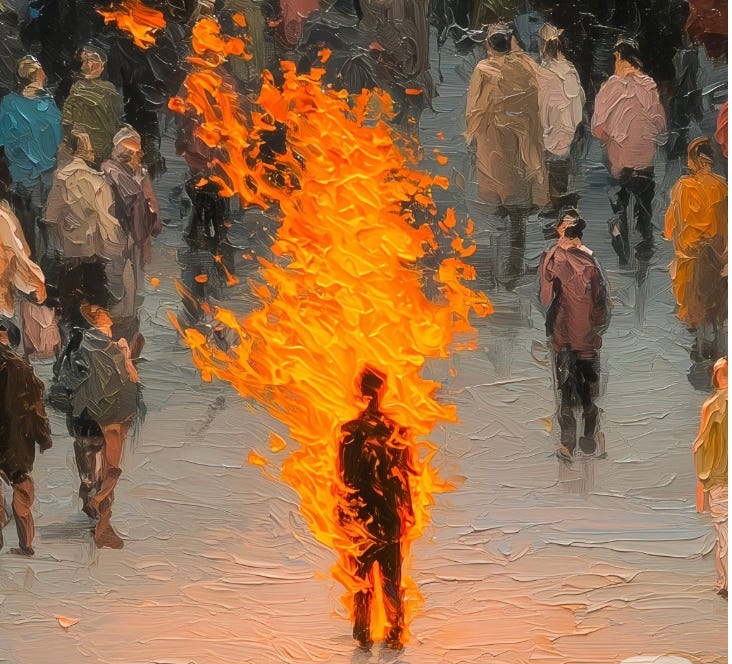
‘Watch the world go up in flames…’
This, incidentally, is my argument for how God and genocide can coexist. If a higher power exists, there is no evidence it is interventionist. Perhaps God is merely positioned a few steps higher on the same bleak viewing platform as the rest of us. She is condemned to watch, just with better visibility.
The problem isn’t that God is cruel. It’s that God might be, quite simply, useless.
So what are we supposed to do down here? We learn. We speak. We hold the gaze for longer than comfort would prefer. Observing alone produces only paralysis; observing together sometimes generates the spark that becomes action. At least, that’s the theory.
But on that flight, as the plume rose and the passengers began to notice, there were no sparks. No cries, no gasps, no whispered prayers. Just a thick, airless silence - the kind that turns a metal tube into a confessional. A plane full of witnesses with no parent onboard to make it stop. That silence is what it feels like when protests in Westminster go ignored: tens of thousands begging their government to intervene, and their government treating them like mildly inconvenient background noise.
Ultimately that is the point of democratic power - to be the adult in the room, the agent capable of converting our horrified observation into institutional action. To wave the wand the public cannot. To shoulder the consequences we cannot bear.
It would be refreshing, revolutionary even, if the people we elect remembered that their job is not to sit in the observation deck with us, but to stand between the plume and the next family boarding a flight home. Otherwise we are all condemned to remain in this metal tube of observational platitude forever: awake enough to see the world burning, powerless enough to do nothing but watch it burn beautifully.
Dear lovely reader,
There are a lot more of you since I last posted! So firstly, welcome.
I would love to hear from you - how this piece made you feel, what your experiences with observational uselessnesss have been, and anything you do that makes you feel, well, a little less useless.
There is a community to join and also a subscription button to press.
See you soon
Kate