MUSING - PHILOSOPHY
Naïve Realism and the Art of Being Wrong About Everything
We assume that we see the world as it truly is - politically, intellectually, romantically. But what if we're just narrating our own delusions?
11 February 2025 · 7 min · Kate

Naïve realism is the delusion that we see the world as it truly is while everyone else—tragically, idiotically—does not. It’s why you’re convinced that your Brexit-loving uncle is brainwashed, while you, a paragon of enlightenment, have simply read the right articles. It’s why we scroll through X, marvelling at the stupidity of strangers, and why we think, against all evidence, that the barista at Pret might secretly be in love with us.
So today, I’d like to examine three areas where naive realism warps our thinking: politics, intellect, and love. Or, as I like to call them, the three pillars of bad decisions.
1. Your Politics Bore Me, But I Still Love You
(On navigating friendships with vastly different political opinions)
You know that moment when a perfectly good evening—wine, laughter, cheese—derails because someone utters the phrase “Well, actually, I think you’ll find…”? Yes, that moment. The one where you suddenly realise that your dear friend, your university confidant, your partner-in-crime at 3 am kebab runs… is politically deranged.
The problem, of course, is naïve realism. The unshakable belief that I see the world as it truly is, while everyone else is trapped in some sort of ideological fever dream. My opinions are rational, balanced, the product of rigorous thought. Yours, meanwhile, are evidence of brainwashing, privilege, or—most damning of all—a failure to read the right think pieces.
This is why your friend has become an extremist, while you remain, conveniently, the sole voice of reason.
But here’s the twist—what if you’re wrong?
(Pause.)
I mean, obviously, you’re not—but what if? …
John Stuart Mill would argue that you need your most irritating friend. In ‘On Liberty’, he suggests that even the most misguided opinions are useful; because in debating them, we either:
a) refine our own arguments or,
b) realise, horrifically, that we were mistaken.
It’s a bit like exercise—you don’t get stronger by lifting weights that agree with you.
Gladstone and Disraeli managed this beautifully. They spent decades slinging political insults at each other, yet still maintained a sort of grudging respect. Today, though, we don’t argue—we block. We unfollow. We curate our ideological bubbles with the precision of a Michelin-starred chef.
Why? Because disagreement used to be a pastime. Now it’s a threat.
Social media rewards certainty, not curiosity. It’s much easier (and frankly, more fun) to post a scathing takedown than to engage in the slow, tedious business of persuasion. But if we all believe we’re right—and surround ourselves with people who confirm it—how do we ever learn?
So, a proposal: The next time you feel the urge to call an old friend a political lost cause, take a breath. Ask yourself—what if I’m the lost cause? A troubling thought. But a necessary one.
2. We Think, Therefore We Scroll
(On the loss of depth in modern thinking)
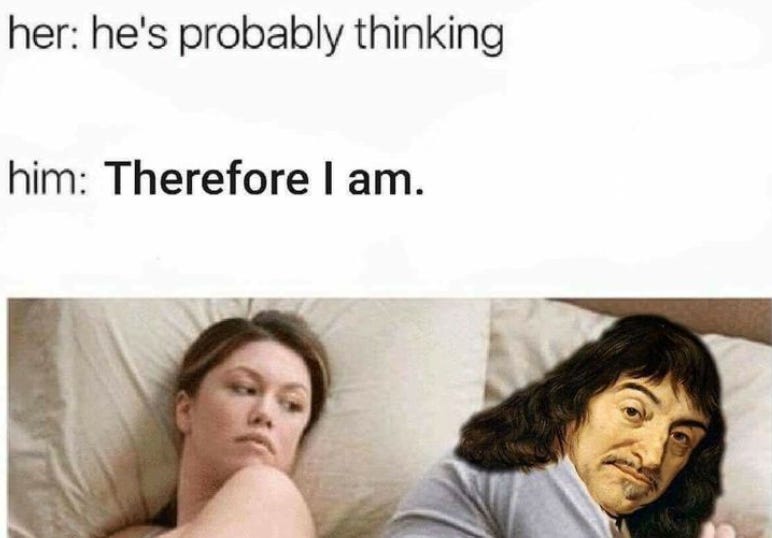
Descartes famously said, “I think, therefore I am.” Today, it’s more like, “I tweet, therefore I’m right.”
We have entered the Age of Certainty. You see it everywhere—someone reads a single headline about a complex issue and suddenly feels qualified to solve geopolitics over brunch. The problem is not just that we don’t read deeply anymore—it’s that we don’t think we need to.
The philosopher Daniel Kahneman talks about “fast” and “slow” thinking. Slow thinking is deliberate, complex, reflective. Fast thinking is reactionary, confident, and—crucially—often wrong. Guess which one social media prefers?
Once upon a time, people would gather over dinner to debate Kant. Now, we consume Nietzsche in TikTok-sized doses, stripped of nuance, ready to be deployed as a clever retort. (“Ah, but Nietzsche said…”) We mistake the ability to recite an aphorism for actual understanding.
Dunning-Kruger explains a lot of this. The less we know, the more we think we know. And social media—bless it—encourages this overconfidence. We can’t all be experts, but we can sound like one in 280 characters.
E.g. Dostoevsky - ‘Depressed Russian says ‘suffer better’…
So, what’s the solution? Read more? Think more? Close the apps and return to the sacred art of philosophical debate?
Maybe.
Or maybe just a little more humility. A little more willingness to say, “I don’t know.” Because, if Socrates was wise enough to admit his own ignorance, we should probably at least consider the possibility that we don’t, in fact, know everything.
3. Can You Be in Love Alone?
(On unrequited love and the romantic delusions we cling to)
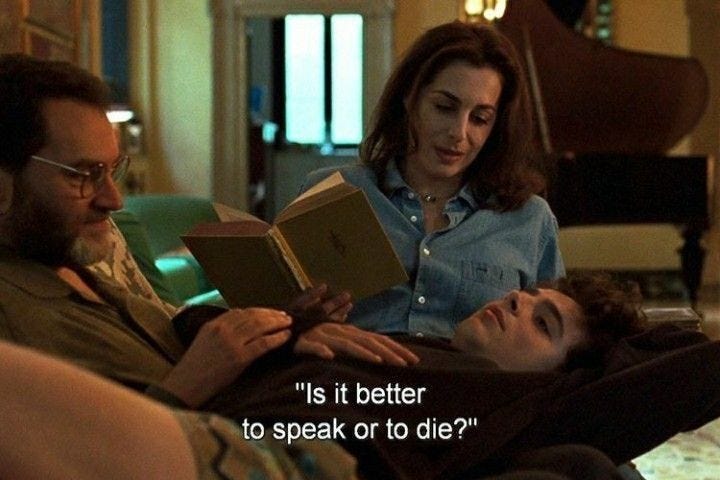
Love is meant to be a shared experience—two people, two perspectives, two utterly incompatible approaches to loading the dishwasher. And yet, for something so supposedly reciprocal, much of human history is filled with people in love alone.
Dante fell for Beatrice at a distance, saw her twice, and spent the rest of his life writing her into divinity. Petrarch did the same with Laura. Werther, of Goethe’s The Sorrows of Young Werther, was so consumed by unrequited love that he made it everyone else’s problem. Even in fiction, unreciprocated love often outshines its mutual counterpart—nobody gets tattoos about the steady, tax-efficient companionship of Mr. and Mrs. Bennet.
The French novelist Stendhal called this crystallisation—the way we embellish the object of our affection, layering fantasy upon reality until we are no longer in love with a person but with a shimmering, idealised version of them. This is why every glance can be read as a hidden confession, every slight pause in a text message as an existential referendum on the relationship.
Naïve realism, of course, plays its part. We assume that our interpretation of events is the accurate one—that the fleeting smile, the long-held gaze, the double tap on an Instagram post from three months ago are all part of a grand, secret language of love, rather than a series of entirely mundane interactions that we have chosen to assign meaning to. We convince ourselves that if we feel something intensely, it must be real, and more importantly, it must be shared.
And the modern world has only made this worse. Unrequited love, once confined to letters and sonnets, now thrives in the digital age. Today, you can fall in love with someone you barely know. You can study their carefully curated online presence, read between the lines of their posts, convince yourself that their choice of song lyrics in a story is an elaborate, coded message directed at you personally. You can be in love with someone who, quite literally, has no idea you exist.
Which raises the question: can you be in love alone?
Of course… But should you be?
Love, in its highest form, is a conversation. It requires engagement, unpredictability, a willingness to be seen in all your flawed humanity. The problem with unrequited love is that it is too neat, too controlled. It is a monologue—one written, directed, and produced by the person experiencing it.
It feels truer than reality, because it is reality as we have chosen to construct it.
And yet, even knowing all this, unrequited love persists. Perhaps because, at its core, it is not just about the other person—it is about us. Our longing, our hope, our ability to take something uncertain and make it feel profound. We would rather believe in a love that may not exist than accept a truth that does.
So, if love is meant to be a dialogue, why do so many of us choose to remain in monologue? Because naïve realism tells us that our version of the story is the truth.
And sometimes, in the absence of real love, that illusion is all we have.
The Common Thread: The Illusion of Objectivity
In politics, in thinking, in love, we are certain that we see things as they truly are.
We are convinced that we are rational, right, justified.
But the truth is, we are all unreliable narrators. Our worldviews are curated, our thoughts shaped by algorithms, our loves tinged with fantasy.
Naïve realism tells us that we understand reality. But the real trick—the harder trick—is to admit that we don’t.
Because maybe you’re wrong about your friend.
Maybe you don’t know as much as you think you do.
And maybe—just maybe—Dante should have just asked Beatrice out for a coffee.
So, dear reader, I’m curious. What’s one belief - about politics, intellect, love or something completely different - that you were once utterly convinced was true, only to later realise you had been completely mistaken?