ESSAY
Bhutan’s Child in the Basement
Can a government make its people happy? And what happens when it can’t?
27 March 2026 · 22 min · Kate

“Imagine that you are creating a fabric of human destiny with the object of making men happy in the end, giving them peace and rest at last, but that it was essential and inevitable to torture to death only one tiny creature, and to found that edifice on its unavenged tears, would you consent to be the architect on those conditions? Tell me, and tell the truth.”
Fyodor Dostoevsky, The Brothers Karamazov (1880)
I. The Festival and the Basement
There is a city called Omelas. It is bright, prosperous, and happy. Its citizens celebrate with a fervour that is neither naïve nor performative but rooted, we are told, in a genuine and abiding contentment. The narrator of Ursula K. Le Guin’s celebrated 1973 short story invites us to imagine this city in whatever terms we find most persuasive — add technology if you like, or subtract it; furnish it with orgies or cathedrals, beer or philosophy. The point is the foundation. For beneath this luminous place, in a basement room with a locked door, sits a single child. The child is malnourished, neglected, terrified. It sits in its own filth. And every citizen of Omelas knows it is there.¹
The bargain is explicit. The city’s happiness, its abundance, its music, its freedom from cruelty, depends, by some mechanism never fully explained, upon the perpetual suffering of this one child. Every citizen, between the ages of eight and twelve, is brought to see the child and told the terms of the arrangement.² Most are horrified. Some weep. But almost all, in time, come to accept it. They return to the festival. A few, however, do not. These are the ones who walk away from Omelas — silently, alone, into a darkness that Le Guin refuses to illuminate.³
Le Guin called the story a “psychomyth” and credited the American philosopher William James with its central provocation.⁴ In his 1891 essay The Moral Philosopher and the Moral Life, James had posed the question of whether one could accept a world of “millions kept permanently happy on the one simple condition that a certain lost soul on the far-off edge of things should lead a life of lonely torment.”⁵ The question originates earlier still in the fevered dialogue of Dostoevsky’s The Brothers Karamazov (1880), where Ivan Karamazov asks whether one would consent to build the edifice of human happiness upon the unavenged tears of one tortured child.⁶ Le Guin’s genius was to translate this abstract dilemma into geography: to give it streets, weather, a Festival of Summer.
This essay proposes that Omelas is not merely a thought experiment. It is a small, mountainous, Buddhist kingdom in the eastern Himalayas, population approximately 780,000, internationally celebrated as the birthplace of Gross National Happiness.
Its name is Bhutan.
II. The Architecture of Happiness
The claim that the state exists to promote the happiness of its people is not, in itself, remarkable. It is arguably the oldest claim in political philosophy. Aristotle, in the Politics, held that the city-state “comes into being for the sake of life but exists for the sake of the good life.”⁷ The theme recurs throughout the work: the most authoritative and highest good of all is the virtue and happiness of the citizens, and the purpose of the city is to make this possible.⁸
But Aristotle was not speaking of happiness as we colloquially understand it in terms of the warm feeling after a good meal or a favourable survey response. He meant eudaimonia: a condition of human flourishing that encompasses virtue, reason, participation in civic life, and the fullest exercise of one’s capacities. As the Encyclopaedia Britannica entry clarifies, eudaimonia “does not consist of a state of mind or a feeling of pleasure or contentment, as ‘happiness’ (as it is commonly used) implies.”⁹
It is the whole life, lived well.
This distinction between happiness as a feeling and happiness as a condition of the whole life is the fault line upon which every subsequent theory of state-delivered happiness eventually fractures.
Jeremy Bentham, writing two millennia after Aristotle, had no patience for such subtleties. He defined as the “fundamental axiom” of his philosophy the principle that “it is the greatest happiness of the greatest number that is the measure of right and wrong.”¹⁰ Where Aristotle spoke of virtue, Bentham spoke of pleasure; where Aristotle invoked the examined life, Bentham devised the felicific calculus — a method for quantifying units of happiness and unhappiness so that the legislator might maximise the former and minimise the latter with something approaching mathematical precision.¹¹
Happiness, for Bentham, was not a byproduct of the good life but the very currency of governance.
John Stuart Mill, Bentham’s intellectual heir, saw the danger in this arithmetic and attempted to refine it. He introduced the doctrine of higher and lower pleasures, insisting that “it is better to be a human being dissatisfied than a pig satisfied; better to be Socrates dissatisfied than a fool satisfied.”¹² He further developed what has come to be known as the Harm Principle: “The only purpose for which power can be rightfully exercised over any member of a civilised community, against his will, is to prevent harm to others.”¹³
Mill’s utilitarianism thus contained within it a structural limit; the individual’s liberty could not simply be dissolved into the collective’s contentment.
But it was John Rawls, in A Theory of Justice (1971), who mounted the most systematic philosophical assault on the idea that aggregate happiness could serve as the organising principle of a just state. Rawls argued explicitly against utilitarianism, which he believed “can justify neglecting minority rights for the majority’s happiness.”¹⁴ His alternative was the celebrated thought experiment of the “original position”: a hypothetical state in which rational agents, shrouded behind a “veil of ignorance” that conceals their future social position, ethnicity, sex, and talents, must choose the principles by which their society will be governed.¹⁵ Rawls proposed that such agents would choose two principles: first, that everyone should have equal basic liberties; and second, that economic inequalities are permissible only if they benefit the least advantaged members of society.¹⁶
The thrust of the argument is unmistakable: in a just society, individuals should not be sacrificed for the greater good.¹⁷
And finally, Amartya Sen’s Capability Approach, first articulated in the 1980s, reframed the entire question. Rather than income, resources, utility, or happiness, Sen proposed that poverty and wellbeing should be considered in terms of people’s “functionings” and “capabilities” i.e. what they are actually able to do and to be.¹⁸ Sen’s most devastating contribution to the happiness debate was his identification of the problem of adaptive preferences: the observation that people who are systematically deprived may adjust their expectations downward until they report themselves satisfied with conditions that are, by any external measure, unjust. In his own words: “The destitute thrown into beggary, the vulnerable landless labourer precariously surviving at the edge of subsistence… all tend to come to terms with their respective predicaments.”¹⁹
Happiness, measured by self-report, can thus become a record not of wellbeing but of resignation.
These five thinkers, Aristotle, Bentham, Mill, Rawls, Sen, constitute the philosophical architecture within which any state’s claim to deliver happiness must be evaluated.
Let us now turn to the state that has made this claim most explicitly.
III. The Kingdom of Measured Joy
The enshrinement of happiness as a policy goal in Bhutan can be traced to the kingdom’s 1729 legal code, which stated that “if the Government cannot create happiness for its people, there is no purpose for the Government to exist.”²⁰ This is a striking formulation — older than Bentham, older than the American Declaration of Independence’s “pursuit of happiness,” and notably more ambitious than either. The American founders promised only the pursuit; Bhutan’s legal code demands the creation.
In 1972, the fourth king of Bhutan, Jigme Singye Wangchuck, gave this ancient aspiration a modern slogan: Gross National Happiness (GNH) is more important than Gross Domestic Product (GDP).²¹ Over the following decades, it was operationalised into a formal GNH Index encompassing nine domains: psychological wellbeing, health, education, time use, cultural diversity and resilience, good governance, community vitality, ecological diversity and resilience, and living standards.²² A GNH Policy Screening Tool was developed and deployed by the GNH Commission, ensuring that no policy could be approved unless it demonstrably contributed to the nation’s happiness.²³ As one official explained to CNN: “If the policy does not have a good amount of happiness index, if the policy is not every environment friendly, if the policy will not be able to ensure that it will result in the well-being of Bhutanese, that policy will never be approved in the country.“²⁴
In 2008, the principle was constitutionally codified: “The State shall strive to promote conditions that will enable the pursuit of Gross National Happiness.”²⁵ Bhutan had achieved something unprecedented in the history of governance; the transformation of happiness from a philosophical aspiration into a constitutional obligation, from an Aristotelian ideal into a Benthamite instrument, complete with screening tools, indices, and policy checklists.
The world was charmed. Travel journalists wrote rapturously of the “last Shangri-La.” Western wellbeing advocates cited Bhutan as proof that an alternative to GDP-obsessed capitalism was possible. In November 2024, Lesley Stahl and her CBS 60 Minutes team toured the country in the company of government ministers, surveying the landscape with visible admiration.²⁶
But here is where the narrator of Omelas would pause, and say: Let me describe one more thing.
IV. The Child in the Basement
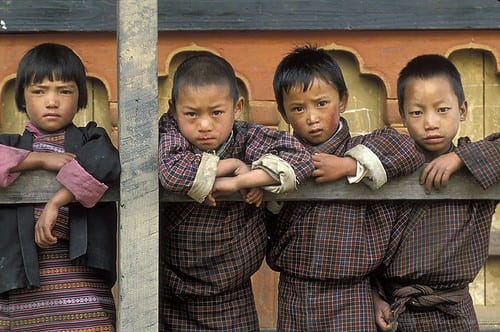
The Lhotshampa are a Bhutanese people of Nepali descent. They had lived in the southern regions of Bhutan since the nineteenth century.²⁷ The term itself means “southern borderlanders” in Dzongkha, the national language.²⁸ By the late twentieth century, they had come to occupy a significant role in Bhutan’s governmental, financial, and agricultural life, serving as bureaucrats, police officers, and soldiers.²⁹ They were estimated by the U.S. Department of State to comprise around 35 per cent of Bhutan’s population.³⁰ Crucially, they were projected to one day constitute a majority.³¹
This demographic trajectory alarmed the Drukpa establishment. In a 1992 interview with the Calcutta Statesman, Bhutanese foreign minister Dawa Tsering stated that an increase in the country’s Nepali population would lead Bhutan to become “another Sikkim and Darjeeling”, meaning territories absorbed into India.³² The fear was existential: the last independent Buddhist kingdom in the Himalayas might lose its cultural identity, as Tibet had lost its to China.
The response was swift and comprehensive. Under the “One Nation, One People” policy, the government replaced Nepali as a classroom language with Dzongkha and forced all citizens to follow the national dress code of the Driglam Namzha.³³ In 1988, a government census recategorised people with Nepali heritage as illegal immigrants.³⁴ If residents could not supply proof that they were Bhutanese residents before 1958, they were deemed to be illegal immigrants; according to human rights groups, even those who could supply the required proof were often evicted.³⁵ Calls for democracy and respect for human rights were termed “acts of treason.”³⁶
Then came the expulsions. After a campaign of escalating harassment in the early 1990s, Bhutanese security forces began removing Lhotshampa families from their homes, first making them sign forms renouncing claims to their property and homeland.³⁷ Human Rights Watch documented the process: state security forces forcibly removed ethnic Lhotshampa and coerced them into renouncing their citizenship.³⁸ One detail, reported by the UAB Institute for Human Rights, possesses a cruelty so refined it could have been invented by Le Guin herself: a Lhotshampa teenager told Human Rights Watch that a soldier, as he was being marched to the border, “told me to smile… He wanted to show that I was leaving my country willingly, happily, that I was not forced to leave.“³⁹
By any definition, what happened in Bhutan between 1989 and 1993 was ethnic cleansing.⁴⁰
The total number of refugees produced was just above 100,000, which is absolutely astounding when measured against Bhutan’s national population. While Bhutan is often portrayed as a modern “Shangri-La,” the seemingly idyllic Himalayan country created more refugees per capita than any other nation in the world in recent history.⁴¹
And the world did not notice. The world’s attention was fixed on the breakup of the Soviet Union, the war in the Balkans, and the genocide in Rwanda.⁴² The quiet, orderly expulsion of one hundred thousand people from a country most Westerners could not locate on a map produced no headlines, no sanctions, no outrage.
The cold calculus behind the expulsion has been laid bare by journalists who have covered the story. The Bhutanese elite “have proudly sold themselves in the West as guardians of an idyllic Buddhist culture. The unspoken implication is that it was necessary to purge these people in order to save the last Buddhist kingdom.”⁴³ And the architect of this purge, the man who decided that a sixth of his country’s population was an acceptable price for cultural preservation, was the very same King Jigme Singye Wangchuck who, in 1972, had coined the phrase Gross National Happiness.⁴⁴
V. The Terms of the Bargain
Let us now do what the citizens of Omelas must do between the ages of eight and twelve: descend to the basement and examine what we find there, in the clear light of philosophy.
The Aristotelian judgement is straightforward and damning. Aristotle insisted that one should call a city-state happy “not by looking at a part of it but at all the citizens.”⁴⁵ The qualifier is precise: all. A polis that achieves contentment by subtraction, by removing from its census the people whose presence complicates the happiness narrative, cannot meet even the most ancient standard for eudaimonia. Moreover, Aristotle’s eudaimonia requires political participation, education, and the exercise of virtue. The Lhotshampa, stripped of citizenship and denied these capacities, are excluded not merely from Bhutan’s territory but from the very conditions of flourishing. A 2005 government census classified 13 per cent of Bhutan’s remaining population as “non-nationals,” denying them the right to vote and a wide range of other rights.⁴⁶ Even those who were not expelled were, in Aristotelian terms, denied the good life.
The Benthamite analysis is more revealing, because Bhutan’s GNH is, in essence, Bentham’s felicific calculus given constitutional form. The nine domains of the GNH Index are an attempt to quantify the components of happiness and screen policy against them. This is precisely the legislative programme Bentham envisioned. But Bentham’s critics always warned that the greatest-happiness principle contained a structural vulnerability: if an action that harms a minority results in greater happiness for the majority, utilitarianism might justify that action, even though it seems unjust.⁴⁷ Bentham’s theory has been criticised for “lacking a principle of fairness embodied in a conception of justice.”⁴⁸ The Lhotshampa expulsion is the empirical realisation of this theoretical vulnerability. The unhappy minority was not outweighed in the calculus; it was removed from the calculus entirely.
Mill would have recognised the danger immediately. He believed that individuals had “a moral obligation to resist the tyranny of majority opinion and to challenge conventional morality when necessary.”⁴⁹ Bhutan’s “One Nation, One People” policy which required all citizens to adopt Drukpa dress, language, and cultural practices, is precisely the species of majoritarian cultural tyranny Mill warned against in On Liberty. The Harm Principle, which holds that power may only be exercised over an individual to prevent harm to others,⁵⁰ is violated not in the margins but at the centre of Bhutan’s happiness project. The Lhotshampa harmed no one by speaking Nepali, wearing their own clothes, or practising their own customs. They were expelled not because they caused harm but because they complicated a narrative.
If we ask the question Mill himself posed “How would a society’s happiness be maximised?”, his answer was “by defending personal freedom of the individuals.”⁵¹ Bhutan inverted this entirely: it maximised its happiness index by removing individuals whose freedom it was unwilling to defend.
Rawls provides the most systematic condemnation. Behind the veil of ignorance, no rational agent would choose to live in a society where one might be stripped of citizenship, forced to sign away one’s home, and expelled at gunpoint on the basis of ethnicity, regardless of how high the resulting society’s happiness index might climb. As Rawls argued, under average utilitarianism, “the basic liberties of some citizens might be restricted for the sake of greater benefits to other citizens. For example, restricting the political and religious liberties of a weak minority.”⁵² Rawls’s first principle of equal basic liberties for all, was violated absolutely. His difference principle, that inequalities are permissible only if they benefit the least advantaged, was inverted: the least advantaged group was not benefited but eliminated.
Sen delivers the final, most philosophically subtle blow. His concept of adaptive preferences explains why Bhutan’s GNH Index might show high scores even after ethnic cleansing, and why such scores are meaningless as measures of justice. A population that has been ethnically homogenised, that no longer contains the voices of those who would have reported discrimination, fear, or dispossession, will naturally produce higher average happiness scores. As Sen warned, “the utility calculus can essentially be unfair to those who have come to terms with their deprivation as a means for survival, adjusting their desires and expectations.”⁵³ The GNH Index measures the happiness of those who remain and the happiness of those who remain is partly constituted by the absence of those who were removed.
Furthermore, the academic literature has explicitly connected Sen’s capability methodology to Bhutan’s GNH Index. The Oxford Poverty and Human Development Initiative has discussed “Bhutan’s innovative extension of the capability methodology in the Gross National Happiness Index.”⁵⁴ The connection is direct: GNH borrows the language of capabilities while violating the philosophical principles that underpin them. Sen himself acknowledged that happiness “is extremely important” and “a momentous achievement in itself,” but emphasised that “happiness cannot be the only thing that we have reason to value, nor the only metric for measuring other things that we value.”⁵⁵
VI. The Anti-Omelas
If Bhutan is Omelas, the city that performs happiness while concealing suffering, then Afghanistan is something like its photographic negative: a state that makes no pretence of happiness and imposes misery with theological conviction.
Afghanistan has ranked last in the World Happiness Report, scoring just 1.3 on a 10-point scale, making it the least happy country among 143 nations surveyed.⁵⁶ It lost approximately 2.7 points between 2013 and 2025, exhibiting both the lowest frequency of positive emotions and the most frequent negative emotions of any country measured.⁵⁷
The reasons are not mysterious. Since August 2021, the Taliban de facto authorities have issued dozens of directives stripping women and girls of their rights, from education and work, to movement and public decision-making. Girls are banned from secondary school. Women are barred from universities, most jobs, and public spaces such as parks, gyms, and sports clubs.⁵⁸ Afghanistan stands out as the only country in the world where secondary and higher education is strictly forbidden to girls and women, with nearly 2.2 million now barred from attending school beyond the primary level.⁵⁹ UN delegates have described the situation as “gender apartheid.”⁶⁰
The Afghan population itself overwhelmingly rejects these policies. In a nationwide survey of more than 2,000 Afghans, 92 per cent said it was “important” for girls to continue their schooling, with support cutting across rural and urban communities.⁶¹ The state, in other words, does not merely fail to deliver happiness; it actively produces unhappiness against the expressed wishes of its own people.
The juxtaposition with Bhutan is instructive not because the two countries are equivalent in their cruelties, they are not, but because they occupy opposite poles of a single philosophical problem: the relationship between state power and human flourishing.
Both states fail every philosophical test surveyed in this essay. Under Aristotle, both deny eudaimonia to large segments of their population, the Lhotshampa through expulsion, Afghan women through exclusion from education and public life. Both ‘call the city happy by looking at a part of it.’ Under Bentham, both manipulate the happiness calculus — Bhutan by removing unhappy people from the population before counting, Afghanistan by not counting at all. Under Mill, both represent the tyranny of the majority and violate the Harm Principle catastrophically. Under Rawls, both fail behind the veil of ignorance: no rational agent would choose a society where one could be expelled for one’s ethnicity or barred from school for one’s sex. Under Sen, both illustrate the limits of subjective happiness as a governance metric.
But Bhutan’s case is the more philosophically interesting, and the more insidious, precisely because it *performs* happiness while enacting exclusion. Afghanistan is openly repressive; the international community condemns it; no one mistakes Taliban governance for a model of human flourishing. Bhutan wraps its exclusions in the language of mindfulness, wellbeing, and Gross National Happiness, and the world applauds. The child in Bhutan’s basement is not merely suffering; it has been photographed smiling on the way out.
This asymmetry illuminates something important about the moral psychology Le Guin was exploring. The horror of Omelas is not the child’s suffering per se, suffering exists everywhere, in every polity, but the knowledge of that suffering combined with the decision to continue the festival regardless. Bhutan’s international admirers, the travel journalists and wellness advocates and 60 Minutes correspondents, are in precisely this position. The information is available. The Human Rights Watch reports have been published. The hundred thousand refugees have been resettled. The choice to continue celebrating Bhutan as a happiness paradise is not made in ignorance; it is made in the full knowledge that the happiness being celebrated was partly purchased by ethnic cleansing.
VII. Building on Cleared Land
In December 2023, the King of Bhutan announced the construction of the Gelephu Mindfulness City. This is a planned metropolis covering 2,500 square kilometres, three times the size of Singapore.⁶² The city promises to embody GNH principles in its very urban fabric: sustainability, mindfulness, and prosperity by design.
The location is Gelephu, in southern Bhutan. It is the heartland of the expelled Lhotshampa.
When Lesley Stahl, standing atop a promontory overlooking the future site of the Mindfulness City, exclaimed, “This is empty right now!”, she failed to note that the only reason the area was empty was because it had been ethnically cleansed.⁶³
For the Lhotshampa in diaspora, the announcement was not an invitation but a wound. One former resident, whose family had owned a thriving three-storey hotel, fourteen acres of farmland, a grocery store, and three homes in Gelephu, was forced out without compensation.⁶⁴ Displaced ethnic Nepalis have accused the government of building the megaproject on stolen land.⁶⁵ As one commentator noted, “The ambitious ‘mega city’ plan is a violent appropriation of the homeland and memories of the displaced Lhotshampa people.”⁶⁶
No refugees have been allowed to return to Bhutan despite negotiations taking place.⁶⁷ The question posed by the Inkstick media outlet remains unanswered: will this city signal an invitation to the 6,300 remaining Lhotshampa in refugee camps in Nepal and the 113,000-strong Lhotshampa diaspora?⁶⁸
The human cost of this diaspora has been severe. For every 100,000 Bhutanese refugees resettled in the United States, 24.4 committed suicide — almost double the rate of 12.4 for the general US population.⁶⁹ A third of the Bhutanese American community lived under the poverty line, more than twice the national average.⁷⁰ More than 92,000 were resettled in the United States, with the largest community, approximately 27,000, settling in Columbus, Ohio.⁷¹
Gelephu Mindfulness City is Omelas rebuilt. It is happiness constructed on the precise coordinates of suffering, designed by world-famous architects, funded by international capital, and marketed with the vocabulary of wellness.
The child has been removed from the basement. The basement has been converted into a meditation centre.
VIII. Can the State Deliver Happiness?
The foregoing analysis permits a synthesis that extends beyond the particular case of Bhutan.
The five philosophical frameworks examined in this essay converge, despite their otherwise significant disagreements, on a single conclusion: a state cannot deliver happiness directly. It can only create the conditions for flourishing, and those conditions must include justice.
Aristotle understood this from the beginning. Happiness, in the eudaimonic sense, is not a feeling that can be administered but a life that must be lived — and lived in conditions of virtue, education, and political participation. As recent scholarship on Aristotelian wellbeing has emphasised, “happiness and well-being are for Aristotle not the primary aims of living… Rather these subjective experiences are byproducts of living well.”⁷²
Bentham’s project of quantifying and legislating happiness, the project Bhutan has most faithfully pursued, was from the outset vulnerable to the objection that it “lacked a principle of fairness embodied in a conception of justice.”⁴⁸
Mill recognised that the maximisation of happiness required, paradoxically, the protection of individual freedom — even when that freedom produced outcomes the majority found uncomfortable.⁵¹
Rawls demonstrated that no rational agent, ignorant of their own position in society, would choose a system that sacrificed the rights of the few for the contentment of the many.⁵²
And Sen showed that happiness, as a self-reported metric, is fatally compromised by the adaptive preferences of those who have learned to expect nothing better.¹⁹
Bhutan’s GNH project confuses an outcome (happiness) with an input (justice, capability, freedom).
A state that makes happiness its explicit organising principle is attempting to legislate a byproduct. One cannot mandate flourishing. One can only create the conditions, being — liberty, education, political participation, material sufficiency, and above all justice — under which flourishing becomes possible.
When those conditions are denied to a sixth of one’s population, and the resulting “happiness” is proclaimed as a national achievement, one is not measuring wellbeing. One is staging it.
The irony is quantifiable. Despite inventing happiness as national policy, Bhutan ranked 95th out of 156 countries in the World Happiness Report 2019.⁷³ The programme has faced criticism from within: Bhutanese citizens have objected that GNH is a distraction from the government’s duty to deliver basic services.⁷⁴ And from the displaced Lhotshampa, the verdict is unsparing. As Balaram Poudyal, president of the Bhutan People’s Party, has stated: “It’s not gross national happiness; it’s gross national sorrow.”⁷⁵
IX. Walking Away, Being Walked Away
In Le Guin’s story, some citizens of Omelas make a choice. They see the child. They understand the terms. And they walk away silently, individually and into the unknown. Their departure is, in the story’s moral architecture, the only available act of integrity. They cannot free the child without destroying the city. They cannot remain in the city without complicity in the child’s suffering. So they leave.
N.K. Jemisin has observed that many readers misunderstand Le Guin as arguing that the only moral response is to leave, when in fact she was arguing that one must “fix” the current society, “especially when there’s nowhere to walk away to.”⁷⁶
For the Lhotshampa, this misreading is not academic. They did not walk away from Omelas. They were marched out at gunpoint, photographed smiling, and resettled across the globe — 85 per cent of them to the United States.⁷⁷ They are not the citizens who rejected the bargain. They are the child in the basement, grown up and scattered to Columbus and Syracuse, Harrisburg and Houston. They are the cost of the festival, living in diaspora, and they were never offered a choice.
And now, on the land from which they were expelled, a Mindfulness City rises. The architects are Danish and the investors are global. The brochures promise harmony with nature and the human spirit. The word “Lhotshampa” does not appear.
Le Guin ended her story with a question she refused to answer: where do the ones who walk away go?
“The place they go towards is a place even less imaginable to most of us than the city of happiness,” she wrote.
For the Lhotshampa, we know exactly where they went. They went to refugee camps in Nepal. They went to public housing in Ohio. They went to minimum-wage jobs and unfamiliar winters and a suicide rate twice the American average.
The ones who were walked away from Omelas did not find a better city on the other side. They found the world as it is — indifferent, distracted, and incurious about the price of someone else’s happiness.
Hello! Wow what a fascinating history Bhutan has. If you enjoyed this read / made it this far, let me know by joining the conversation over on my chat.
See you on the next one!
Kate